

Conversion rate of the test-drive request form after Kia Germany applied the recommended changes.
More prospects corrected an error after a failed submit and still requested their test drive.
Higher start rate on the form, alongside a +16% submit rate and a +22% autofill rate.
About Kia Germany
Kia Germany runs the German brand website of the car manufacturer Kia. On that site, prospects can request a test drive at a Kia dealer through a test-drive request form. The form receives a steady flow of traffic, and web form performance is one of Kia Germany’s priorities.
Kia Germany uses marketing technology from Zeta Global to reach and engage its audience. To get more out of its web forms, the team added Exatom’s form analytics alongside that platform. Exatom is a Zeta Global partner.
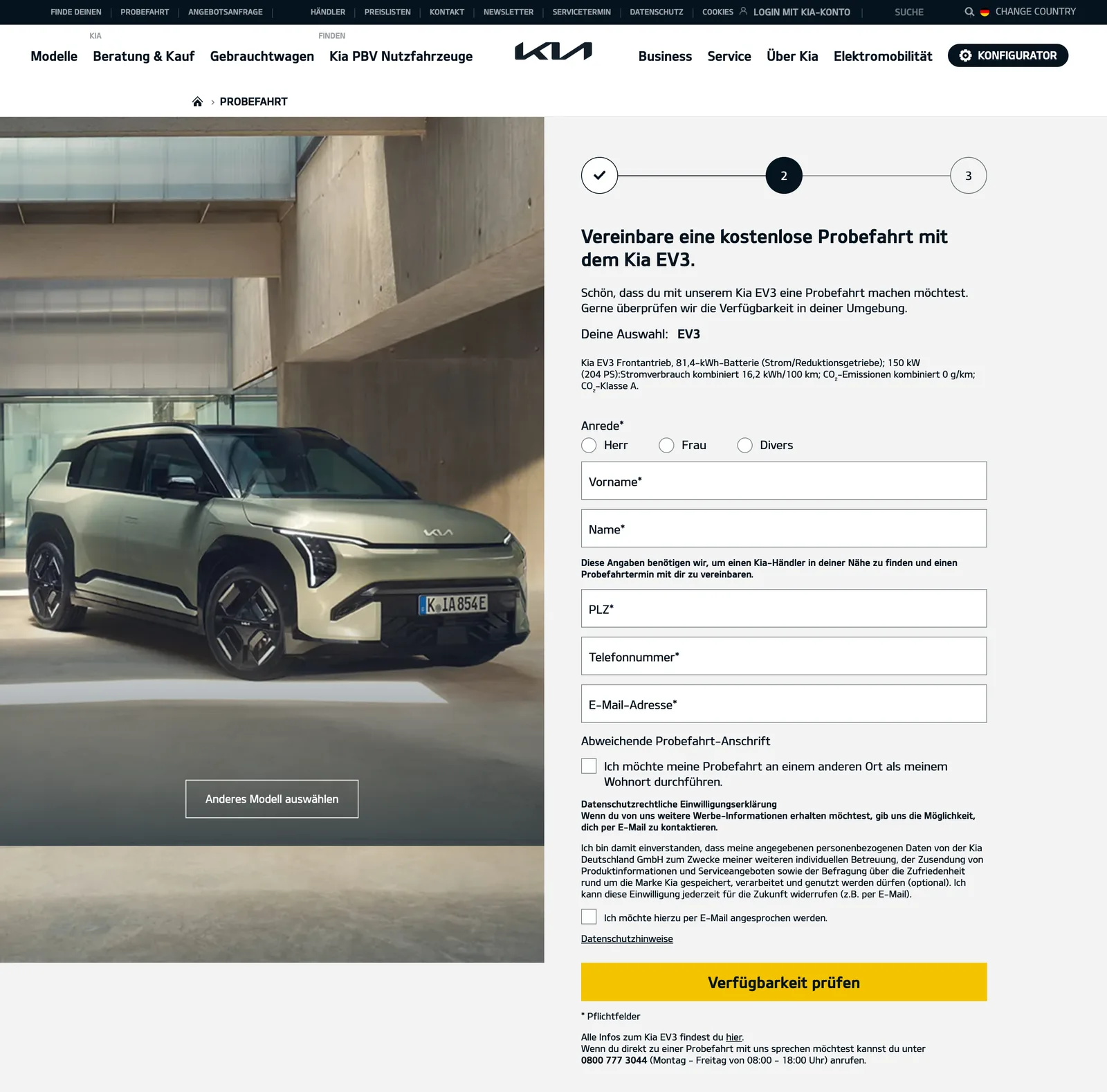
Kia Germany’s test-drive request form, the form this story is about.
The challenge
Kia Germany wanted to raise the conversion rate of its web forms and reduce friction for visitors at the same time. Traffic to the brand website was steady, but a significant share of prospects left the test-drive form without completing it. The team knew there was friction in the form. What it could not see was where that friction sat, or why prospects abandoned. The tools they had showed traffic arriving at the form and requests coming out of it. Everything that happened between the fields stayed invisible.
Without field-level data, a targeted improvement was impossible, so every change to the form would have been a guess.
- No view of hesitation. There was no field-by-field data on where prospects paused or how long they spent on each field.
- No view of errors. Nobody could see which fields produced error messages, or whether prospects who hit an error went on to submit.
- No view of autofill. It was unclear how often the browser filled fields in automatically, and where that failed.
- A cost beyond the form. Abandonment is a consequence of friction, and every prospect who left also lowered the return on the marketing budget spent to bring traffic to the site.
The objective was to understand how prospects behaved inside the test-drive form, and to use that understanding to raise its conversion rate.
The solution
Kia Germany chose Exatom to get that insight. Implementation required a single tag. The tag finds all forms on the website automatically and gathers the relevant form and field metrics, including those of the test-drive form.
Exatom looked at the form on three levels: how visitors interacted with the form as a whole, how each individual field performed, and what the recorded sessions on the form showed. The analysis led to a detailed list of recommendations covering technical, design and content changes. Kia Germany applied them to the test-drive form.
The collaboration did not end with one list. Jean-Philippe Pottier, Manager Digital Platforms at Kia Germany, describes it like this.
Using the tools from Exatom, helped us to first understand the customers behaviour and improving the UX and CX of several forms. The results are higher as the expectations, which encouraged us to search for additional partnerships with Exatom.
The team from Exatom is always providing constant recommendations and new ideas. Their professional behaviour combined to their knowledge make them the perfect partner for a modern CRM environment.
Jean-Philippe Pottier
Manager Digital Platforms, Kia Germany
How Exatom helps Kia Germany
Measuring what happened between the first click and the submit button
The first question was where in the journey prospects got stuck. With Form analytics, Exatom measured form starts, failed submits, successful resubmits and the number of errors, split per device and per browser. That view showed the specific areas of the form where visitors had difficulties or hesitated, instead of one conversion figure for the whole form. After the changes, the start rate of the form rose by 21% and the submit rate by 16%, which means more prospects began the form and fewer abandoned it once they had started.
Reading every field on its own
A form-level view says that prospects leave. A field-level view says where. Exatom reported per field on abandon rate, time spent, autofill use, hesitation time and error rate, which exposed the bottlenecks and usability issues in the test-drive form one field at a time. After the changes, the autofill rate rose by 22%, so the browser completed more fields for prospects automatically.
Watching the sessions behind the numbers
Numbers show where friction sits, not always why. Exatom’s Session replay recorded the journey on the form itself, from landing on the form to completing it, and linked each session to the form analytics. That made it straightforward to go from a field with a high error or abandon rate to the sessions that showed what prospects actually did there, and why they perceived friction. It gave Kia Germany a clear basis for targeted improvements.
Helping prospects recover from a failed submit
One improvement stood out in the before and after data. Before the changes, out of every 100 prospects whose first submit failed, 10 corrected the error and submitted successfully, and 90 abandoned. After Kia Germany applied the recommendations, 42 out of every 100 recovered and 58 abandoned. Four times as many prospects were able and willing to correct an error and still request their test drive, turning a failed submit from a dead end into a second chance.
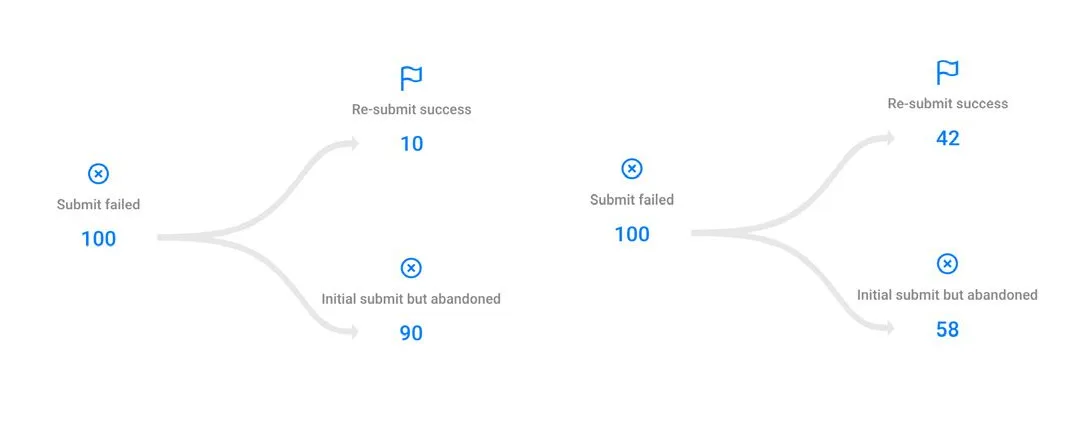
Out of every 100 failed submits, successful resubmits rose from 10 before the changes to 42 after them.
The results
- +55% conversion rate on the test-drive request form, driven by the technical, design and content changes Kia Germany made once field-level data showed where prospects dropped out.
- +21% start rate and +16% submit rate, driven by the same recommendations, so more prospects began the form and fewer abandoned it after they had started.
- +22% autofill rate, driven by changes that let the browser fill in more fields automatically.
- 4x more successful resubmits, driven by making it easier for prospects to correct an error after a failed submit, with 42 instead of 10 out of every 100 recovering.
The improvement worked in two directions at once. Prospects found the form easier to navigate and complete, and Kia Germany received more quality leads from the same form, with a positive impact on business growth. The results came out higher than the team had expected, and that encouraged Kia Germany to look for additional partnerships with Exatom.
What’s next
Kia Germany treats web form optimisation as a continual process rather than a one-off project. Beyond optimising its existing forms, the team went on to test Smart Nudges, then called Smart Tooltips: contextual messages that guide prospects through a form at the moment they hesitate.
Two further steps would fit on top of this work. Autofixes apply technical corrections such as input types and autocomplete settings without a development sprint, and Webform monitoring flags a form that suddenly stops converting before a campaign report does. For another automotive brand working on the same conversion moment, read how Hyundai optimised its test-drive request form. To see what your own test-drive form is losing, book a demo.