

Conversion on the renewed online ordering process, with field-level insight as a key contributor.
Drop-off on the IBAN field, from 14.9% to 8.6%, after asking for the full IBAN with an explanation.
Time for a change to show in the data, now a routine for Digital, Marketing, IT, Sales and Legal.
About DELTA Fiber
DELTA Fiber builds and operates fibre networks in the Netherlands and delivers gigabit internet, interactive television, telephony and mobile services over them. Telecom is a commodity market. The product is rarely what makes the difference; the experience of ordering it usually is.
The online ordering flow for fixed services (internet, TV and telephone) had been the subject of conversion optimisation for years. Every step was monitored and optimisation was part of the daily routine. What the team needed next was depth: insight into what happens inside each step, down to the individual field.
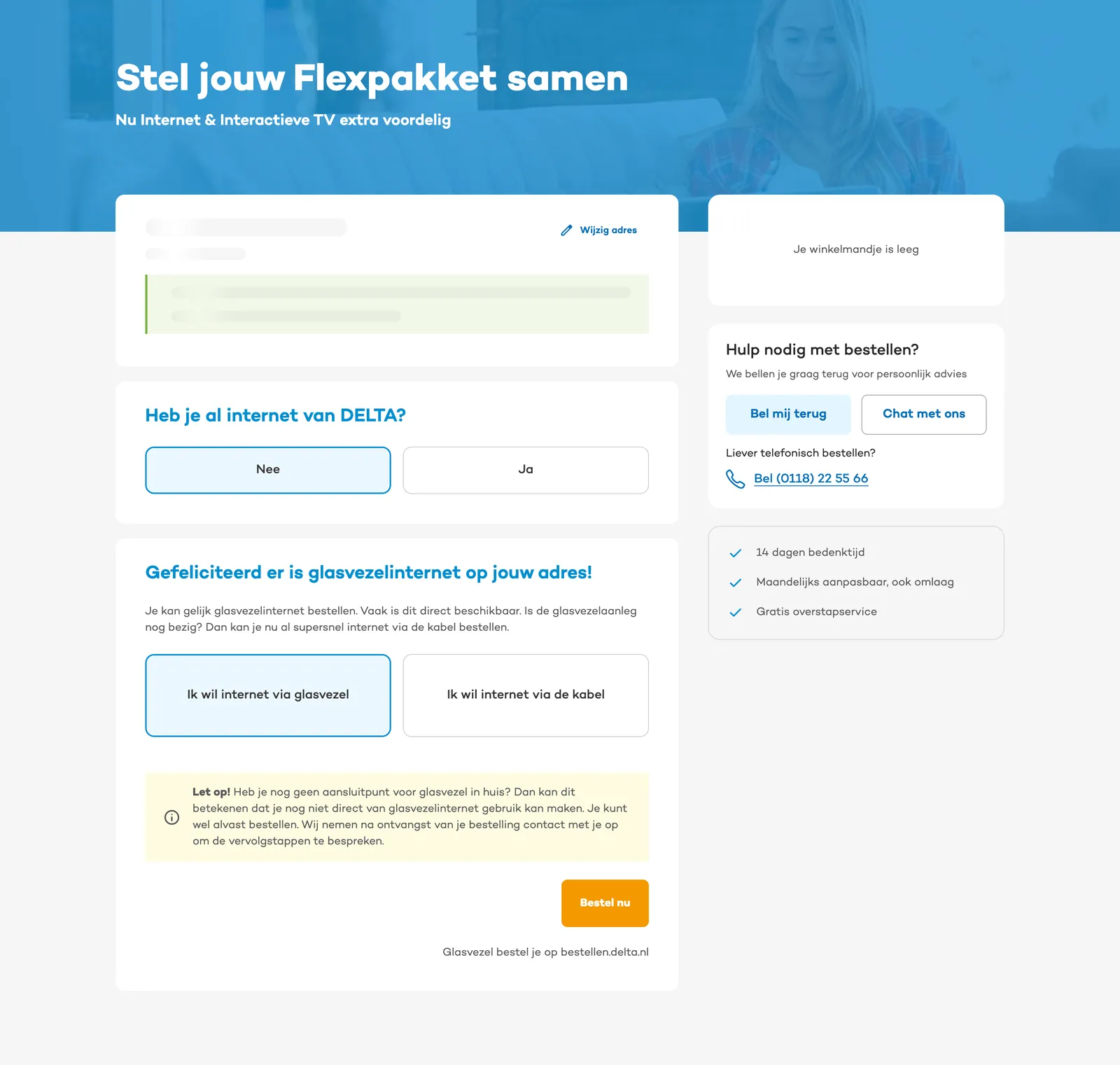
The first step of DELTA Fiber’s online ordering flow, where buyers put their internet and TV package together.
The challenge
DELTA Fiber had a wide range of research methods at its disposal: extensive web analytics, customer interviews and countless A/B tests. Hypotheses were validated continuously, on a flow that thousands of visitors enter every day. Yet all of it showed the same thing. The team could see at step level where buyers dropped out of the order, but not what was actually going wrong at the level of a field or an interaction.
After years of investment in conversion optimisation, the team knew where buyers abandoned the order, but not why.
- Step-level data only. The existing analyses reported drop-off per step, with nothing underneath it at field level.
- Micro-interactions were a blind spot. Where buyers made mistakes, went back or hesitated stayed invisible, so details that quietly cost revenue went unnoticed.
- Decisions still leaned on assumptions. Despite all the measuring and testing, part of the roadmap rested on assumptions about where the friction was.
- Small friction is expensive in telecom. In a highly competitive market, a little friction in the order flow is enough to lose the buyer.
The objective was to open the black box and make the ordering flow visible down to the individual field.
The solution
The collaboration started with a pilot in the summer of 2023, with Yellowgrape, DELTA Fiber’s strategic partner for conversion, and Exatom working together on the ordering flow for fixed services. Form analytics measured that flow field by field. Within four weeks the data had challenged assumptions the team had held for a long time. Three parts of the flow proved to be the biggest stumbling blocks: the installation date, the address validation and the IBAN field.
The roles were clear from the start. Exatom supplies the field-level insight. Yellowgrape translates it into design choices, A/B tests and technical improvements. DELTA Fiber implements, and made sure fixes went live quickly despite a full backlog. The first improvements were visible in the data within 72 hours.
After the fixed services flow, the same approach was applied to the mobile ordering flow. What started as a pilot became a continuous cycle of analysing, testing, improving and measuring again.
How Exatom helps DELTA Fiber
Making every field in the ordering flow measurable
The existing reports stopped at the step. Form analytics went one level deeper and showed, per field, where buyers made mistakes, went back or dropped out, together with interaction time, hesitation time and corrections. Within the four weeks of the pilot, that turned a long list of possible explanations into three concrete stumbling blocks, and the work started there.
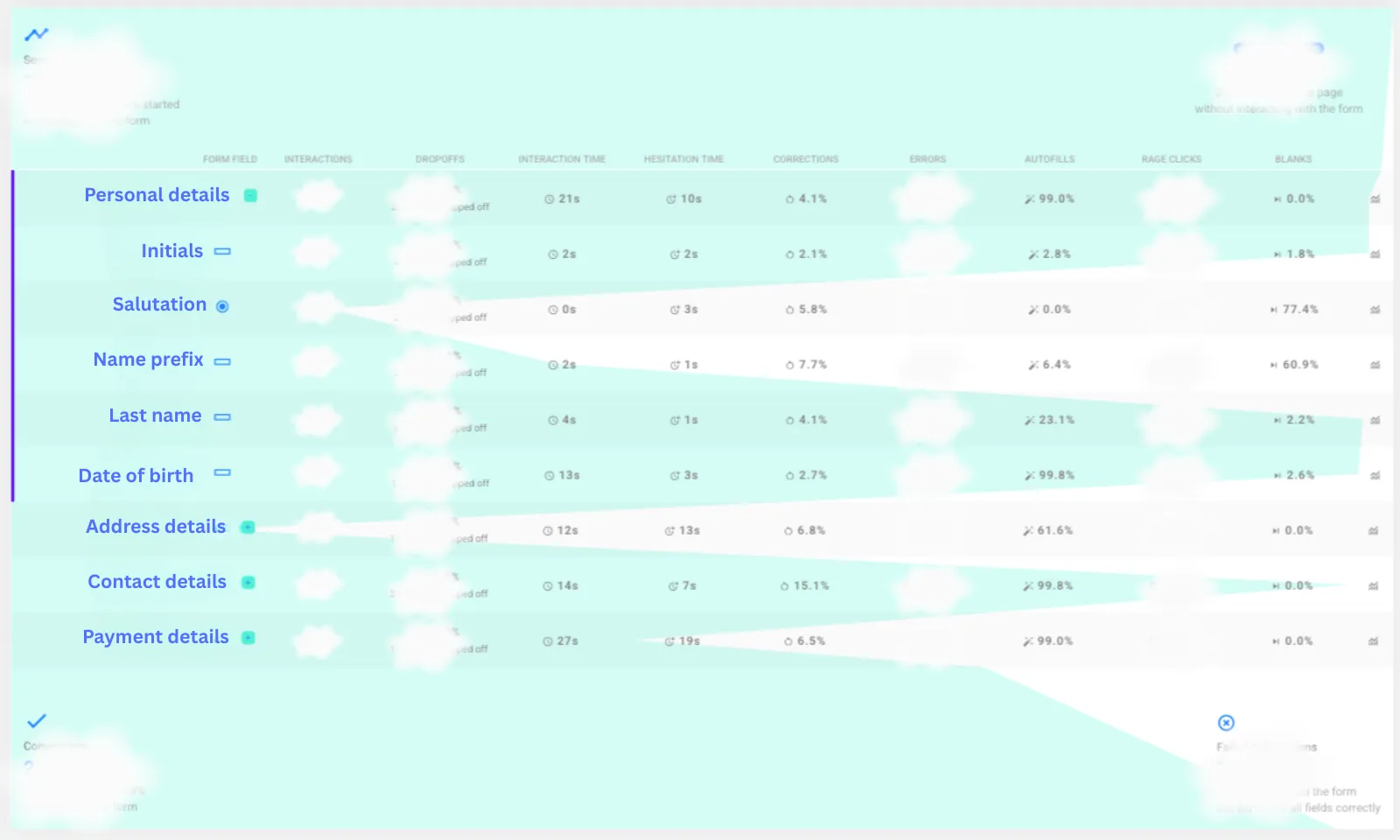
Field-level analysis in Exatom for one step of the order form: interaction time, hesitation, corrections and autofill per field (some values blurred).
Asking for the full IBAN, and saying why
The switching service retrieves the buyer’s contract from their previous provider. Its IBAN field asked only for the last three digits, on the assumption that asking for less would make the step easier. The data showed the opposite: a drop-off of 14.9% on the field and an interaction time of 20 seconds. The team changed the field to ask for the full IBAN and added a short explanation of why it was needed. Drop-off in that step fell to 8.6%, a reduction of 40%. Asking for more caused less friction, as long as the reason for asking was clear.
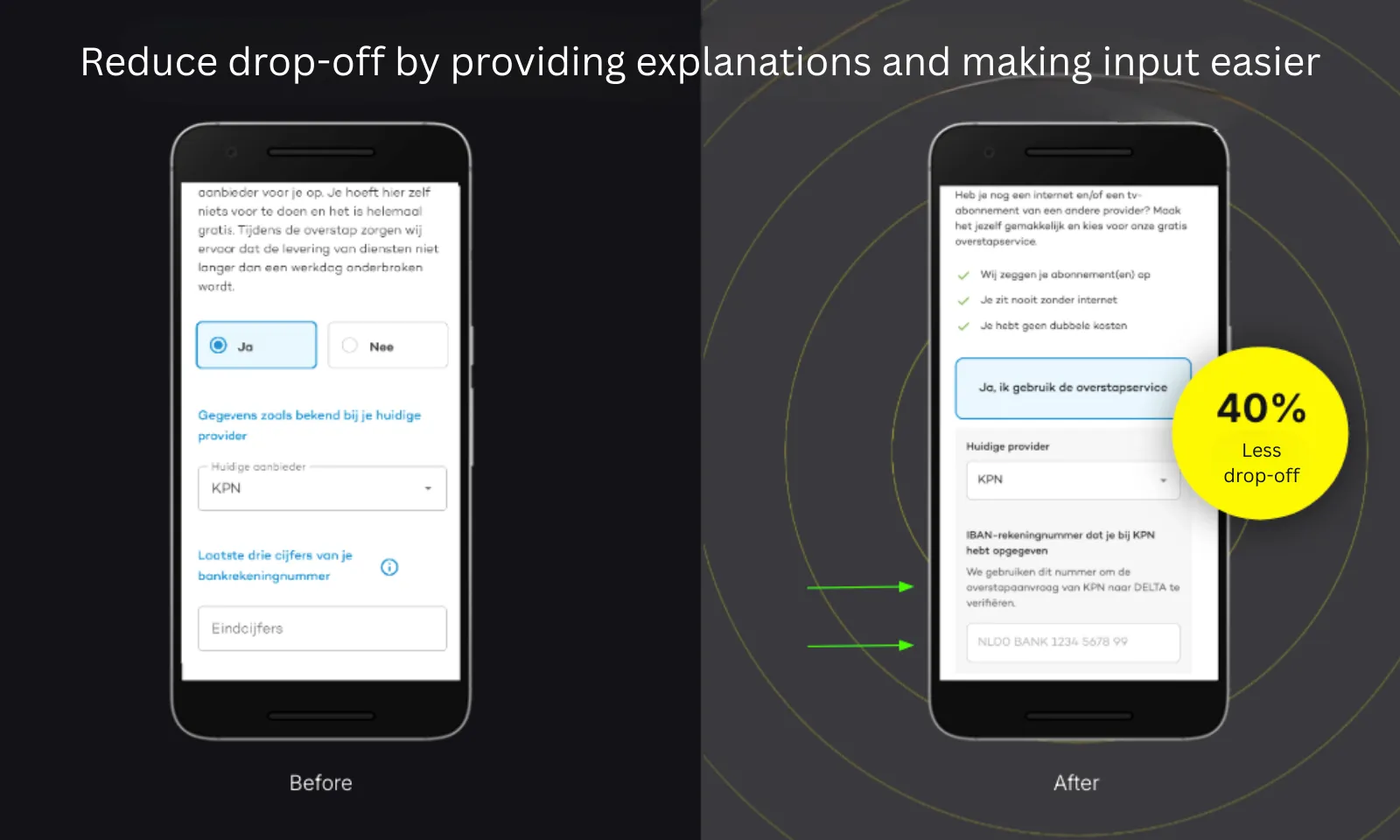
The IBAN field in the switching service, before and after. The full IBAN with an explanation cut drop-off by 40%.
Offering the earliest appointment for the installation
Choosing when the engineer would come was the second stumbling block. Buyers had to pick the moment themselves. After the change, an option for the earliest possible moment was shown next to the free choice. That took away much of the doubt, and form analytics showed it: hesitation time fell from 42 to 19 seconds, and drop-off on the step fell from 24.1% to 18.4%.
Turning findings into a continuous test and fix cycle
Single fixes are worth less than a routine that keeps producing them. Yellowgrape used the field-level findings to fill the A/B testing roadmap. Other problems were solved where they arose, with improved field validation and clearer microcopy. The same loop now runs on the mobile ordering flow, and new products, prices and promotions are tested and improved on the same data.
The results
- +22% conversion on the renewed ordering process, with field-level insight contributing significantly to the redesign, starting with the IBAN field and the installation date step.
- IBAN field drop-off down 40%, from 14.9% to 8.6%, by asking for the full IBAN with an explanation instead of three digits without context.
- Installation date hesitation down from 42 to 19 seconds, with drop-off on the step falling from 24.1% to 18.4%, by showing the earliest possible moment next to the free choice.
- First improvements visible within 72 hours, because measurement runs continuously and every change shows up in the same field-level data.
The +22% covers the new ordering process as a whole and is not down to Exatom alone, but the field-level insights contributed significantly to it. Perhaps more important is how the work is organised now. Optimisation is no longer a one-off project but a fixed part of daily operations. Teams from Digital, Marketing, IT, Sales and Legal work on the ordering process together, based on Exatom data.
Yellowgrape and Exatom helped us gain crucial, in-depth insights. We now know exactly which details in the ordering process make or break conversion.
Robert de Kok
Digital Growth Strategist, DELTA Fiber
What’s next
At DELTA Fiber, data analysis is no longer a snapshot but an ongoing process. While the sales funnels are refined further, the focus is widening to retention and service in the Mijn DELTA environment. There too, every click is a chance to reduce friction and increase conversion.
For a team that already works this way, a few additions are a logical next step. These are suggestions, not deployments. Session replay shows the individual sessions behind a drop-off figure. Smart Nudges and Autofixes act on hesitation and input errors while the buyer is still in the form. Webform monitoring flags a step that stops converting, in a flow that changes with every new product, price or promotion. Eureka turns the same field-level data into prioritised recommendations.