
More quote requests, with lead form conversion rising from 4.5% to 16.7%.
More leads from the same traffic and the same campaign budget.
Campaign budget needed to reach the same result as before.
About Beter Duurzaam
Beter Duurzaam helps homeowners and businesses make their energy use more sustainable, with solar panels, home batteries, heat pumps, EV charging stations and air conditioning. Visitors use the website to work out which option fits their situation, then request a quote or an advice conversation through a multi-step lead form. That form is where interest either turns into a sales conversation or disappears.
As the company grew, its old website no longer gave it the flexibility and conversion it needed. The agency Webwavers rebuilt the site on WordPress, which cut website costs by 75% and kept the existing SEO value in place. Webwavers used Exatom in that project, with the form optimisation as one part of a broader CRO approach.
The challenge
The new website had a better structure and stronger calls to action, but the lead form stayed at 4.5% conversion, which meant a drop-off of around 95.5%. There was no tool on the form before Exatom, so that single percentage was all anyone could see. Everyone knew prospects were dropping off. Nobody knew where.
Without field-level data, the form was one conversion rate, and every idea for improving it was an opinion.
- Five separate address fields. Every one of them was another chance to slow down, mistype or give up.
- Dropdowns that hid the choices. Prospects had to open a list before they could see what was on offer.
- One question set for homeowners and businesses. Both answered the same questions, although their situations are different.
- Fields that were not needed. The form asked for information that turned out not to be necessary.
- Too little context. The form gave prospects little explanation around the questions it asked.
The objective was to find the questions that cost the most quote requests, and to rebuild those first.
The solution
Once the new website was live, Webwavers put Exatom on the lead form. Form analytics measured every field of the multi-step form separately, so the single 4.5% became a picture of where prospects abandoned, hesitated and made mistakes.
That picture was blunt. 45% of prospects dropped off at the question about their role and the choice of a home battery. 50% dropped off at the question asking whether they wanted help with subsidies. The redesign that followed took two months and went after those questions first, instead of spreading changes evenly over the form.
How Exatom helps Beter Duurzaam
Finding the questions that cost the most requests
Before Exatom, the form had one number. Form analytics recorded drop-off for each field of each step, which showed that the loss was not spread evenly. It was concentrated around a few questions: the role question and the home battery choice at 45% drop-off, and the subsidy question at 50%. Every change that followed was checked against those fields.
Replacing five address fields with a postcode lookup
Address entry was the longest stretch of typing in the form, spread over five separate fields. It was replaced by an address scanner that finds the address from a postcode and a house number. Prospects type two short entries instead of five, and most of the manual input that caused typing errors disappears with it.
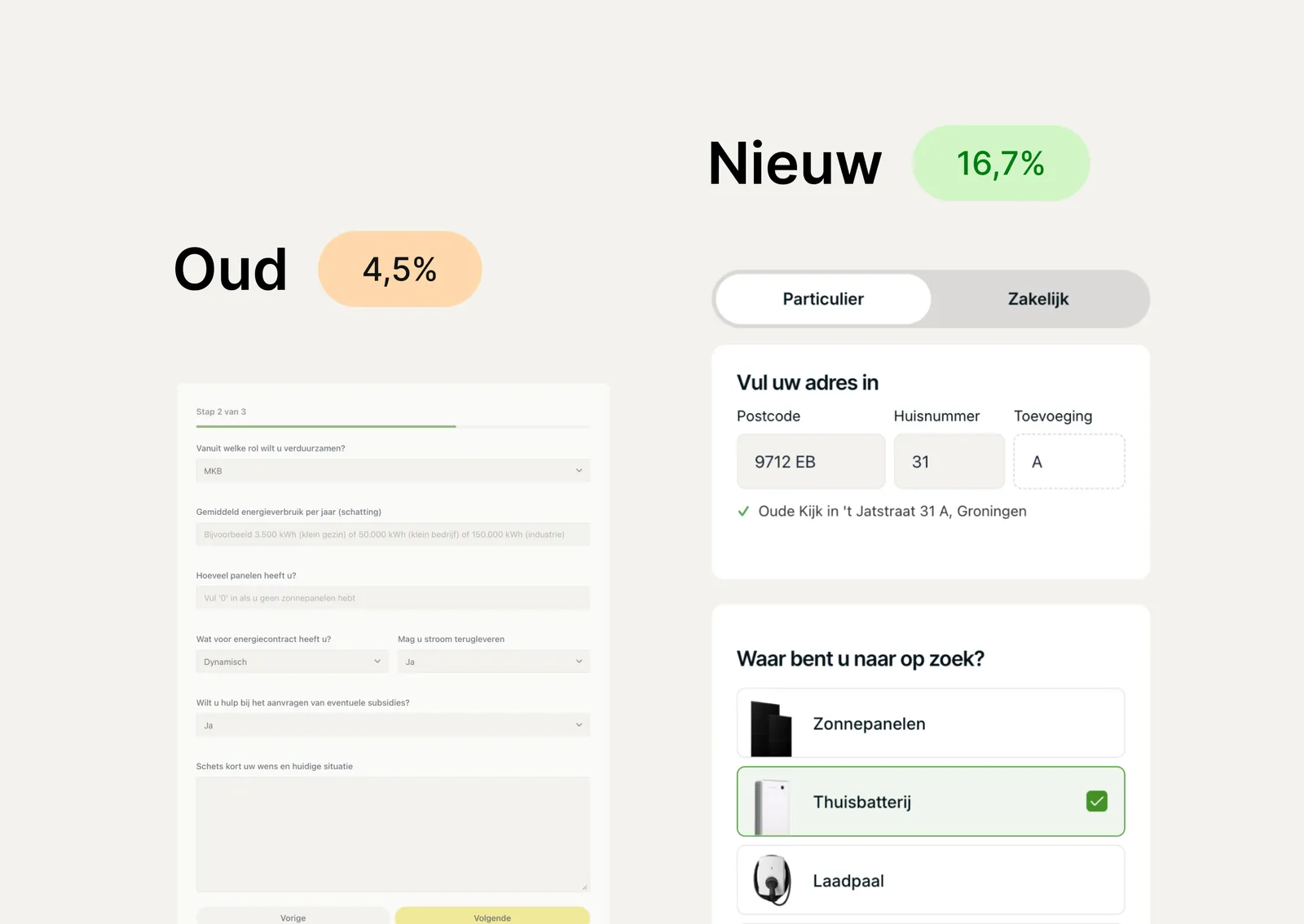
The lead form before (4.5% conversion) and after the redesign (16.7%): a choice between private and business, a postcode lookup and visible options instead of dropdowns.
Showing the choices and asking only what matters
The dropdowns were replaced with selection options that are visible straight away, so a prospect sees what is on offer without opening anything. Two fields that were not needed were removed. Homeowners and businesses now each get their own set of questions, so each answers what fits their situation. Autofill was improved on name, email address and telephone number, which takes another round of typing out of the form on a phone.
Explaining why the form asks what it asks
The last change added better context around the form itself, explaining why information is needed and what happens next. It is aimed at the kind of doubt the field-level data had exposed at the subsidy question, which was losing half of the prospects who reached it.
The results
- +271% more quote requests, with lead form conversion rising from 4.5% to 16.7%, by rebuilding the questions the field-level data showed were losing the most prospects.
- 3.5x more leads from the same traffic and budget, because the gain came from inside the form rather than from buying more visitors.
- 70% less campaign budget needed for the same result, the same effect seen from the other side: a form that converts better needs fewer visitors to produce the same number of requests.
- Two months from first analysis to a rebuilt form, because the changes were aimed at the fields that mattered instead of the whole form at once.
The website rebuild and the form optimisation were two projects that reinforced each other. The rebuild brought the lower costs, the flexibility and the better structure, but on its own it did not move the form: conversion stayed at 4.5%. The field-level analysis showed where prospects were leaving, and the changes that followed took the form to 16.7%. What Beter Duurzaam gained beyond the numbers is a way to settle questions about the form. Which question to change next is no longer a matter of taste but a measurement.
What’s next
A form that converts at 16.7% still has room to grow, and the same method applies to what is left. With separate question sets in place, the next round can compare how homeowners and businesses behave in the parts of the form they share.
A few additions fit naturally onto what is already running. These are suggestions, not deployments. Session replay shows the individual sessions behind a field that underperforms. Smart Nudges act on hesitation while the prospect is still in the form, and Autofixes correct input problems before validation rejects them. Webform monitoring flags a form that stops converting before the drop in requests shows up in sales, and Eureka turns the field-level data into a prioritised list of what to fix next.