
Checkout completion rate on the final step with the winning Smart Nudge.
Less checkout abandonment on the final step with the same winning variant.
Smart Nudges A/B tested against a control group, each group with 25% of traffic.
About INNO
INNO is the largest luxury retailer in Belgium, with 16 physical department stores and a webshop at inno.be. It is a well-known and established store brand, and it celebrated its 125th anniversary in 2022.
INNO’s ecommerce team works with Envoker, a Dutch performance agency, on performance marketing: SEO, SEA and display campaigns aimed at more conversions. Envoker in turn works with Exatom on form and checkout optimisation, and that is how INNO’s checkout came onto the table.
The challenge
A product in the cart is not a sale. Even a buyer who starts the checkout is no guarantee of an order, and every webshop has to deal with a share of buyers who abandon along the way.
INNO has a three-step checkout. The existing analytics showed clearly how many buyers moved on to the next step and how many ordered in the end. What happened inside each step, how buyers behaved on the fields, was a blind spot, and none of the tools INNO had could show it.
Of the buyers who reached the final checkout step, 30% still left without ordering.
- Almost nothing left to do. On the final step buyers only had to review their order and the products, and tick the box to agree to the terms and conditions.
- Steps, not fields. The existing analytics counted buyers per step, but not what they did on the fields within a step.
- No reason in sight. Without field-level behaviour, there was no way to tell why buyers who had come this far still turned back.
The objective was to understand how buyers behave from cart to checkout to order, turn that into recommendations, and prove the best one in an A/B test.
The solution
Envoker and Exatom started with form analytics on INNO’s checkout, to see how buyers behaved on every data input field from the cart to the order. The project covered three parts: analysing the insights, making recommendations and running an A/B test.
The analysis put a number on the conversions missed on the final step. It also showed that the drop-off there had no technical or UX cause. The step worked; buyers simply did not finish it. That made it a question of motivation rather than function, which is the third level of Exatom’s form optimisation pyramid.
So the fix was not a redesign. Exatom and Envoker set up a motivational Smart Nudge campaign, then called Smart Tooltips: a short message with microcopy that appears next to a field, triggered by what the buyer does.
How Exatom helps INNO
Putting a number on the conversions lost at the last step
The first task was to measure the checkout step by step and field by field. Form analytics showed where buyers left within each step, not only between steps.
One result stood out. On the final step, where buyers only had to review their order and tick the terms checkbox, 30% of the buyers who arrived still abandoned the checkout. With no technical or UX cause, the drop-off had a motivational cause rather than a functional one. The buyers needed a reason to finish.
Triggering the nudge on hesitation, not on page load
The nudge did not appear for every buyer. It was triggered by deviant hesitation. The platform calculates an expected hesitation time for the terms checkbox and shows the nudge as soon as a buyer’s hesitation deviates significantly from that expectation.
The nudge also closed itself. A countdown of 12 seconds ran on the message, after which it closed automatically.
The Smart Nudge on INNO’s final checkout step: it appears when the hesitation at the terms checkbox deviates from the expected time, and closes itself after a 12-second countdown.
Testing three variants against a control group
Rather than guess which message would work, the team tested three. Buyers were split at random into four groups of 25%: a control group without a nudge, and three groups that each saw a different version.
- Group B: red copy on a light grey background, “One more check and you’re done”
- Group C: white copy on a black background, “One more check and you’re done”
- Group D: white copy on a black background, “Our Crazy Days promotion is ending. Still benefit from it today”
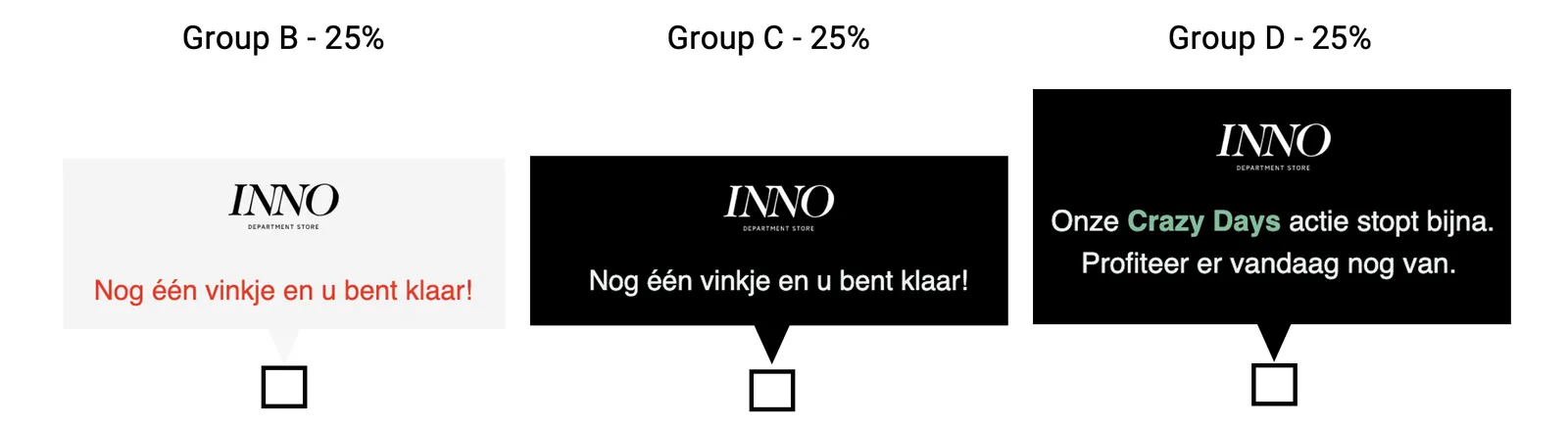
The three Smart Nudge variants INNO tested on the terms checkbox, in the Dutch version of the checkout.
Letting the data pick the winner
Every version delivered extra conversions, but the differences were large. The two black versions with white copy lifted conversion by 3% to 4%. The light grey version with red copy delivered more than 10% more successful checkouts.
None of the stakeholders expected the red version to win. Testing several variants against a control group is what found it.
The results
- +10.2% checkout completion rate on the final step, from the red-copy nudge on a light grey background that appeared when a buyer hesitated at the terms checkbox.
- More than 30% less checkout abandonment on the final step, with the same winning variant, on a step that had no technical or UX fault to fix.
- +3% to +4% conversion uplift from the two black variants, so even the weaker creatives added conversions.
- A winner nobody predicted, because none of the stakeholders expected the red-copy version to come out on top.
The lesson went beyond one checkbox. Nudging a buyer with a motivational message on a form or checkout proved an effective ecommerce tactic. Just as important, the test showed that A/B testing several versions is essential, because experienced marketers can be wrong about which message wins.
The unique thing about Exatom is that it provides substantive insight into your web forms.
Cees Krijger
Senior Online Marketeer, Envoker

What’s next
The motivational nudge campaigns continue as ongoing experiments, to improve INNO’s checkout and account creation forms further. With Envoker, the team also looked at the buyers who had abandoned the checkout and tested a new retargeting strategy on that group.
For a checkout at this stage, there are logical next steps. Autofixes correct technical input problems on forms such as account creation without a developer, and session replay shows what hesitating buyers actually do before they leave. Other retailers took related routes: Brooks Running EMEA combined field fixes and Smart Nudges across its European webshops, and Bruna went through its checkout field by field. To see where your own checkout loses buyers, book a demo or compare the plans on the pricing page.