
Friction in the checkout and account registration found per field and acted on, from autofill attributes to the mobile pay button.
Removed outright: the required salutation field, the biggest source of error messages in step one.
No consent banner needed, so no consent loss skewed the checkout data.
About Bruna
Bruna is a Dutch bookstore. It sells directly online and runs a nationwide network of physical stores, and it is part of Audax. That gives its website a dual role: it is a direct sales channel and an important lead channel for the stores. Audax’s drive-to-store strategy shows up at several moments in the customer journey, so every change in the checkout affects both online conversion and store visits.
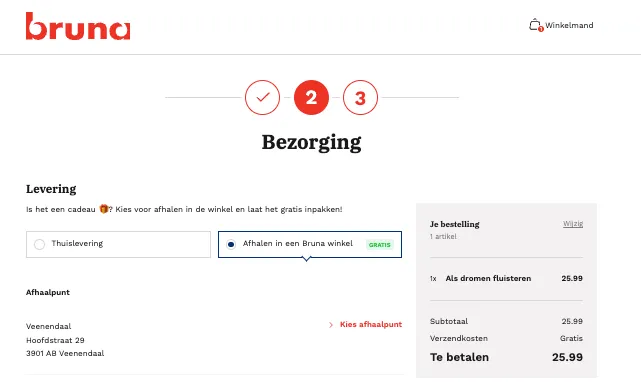
Step two of the Bruna checkout, where buyers choose between home delivery and free pick-up in a Bruna store. This project was a partnership of three. NeoSEM, Bruna’s existing online marketing agency, turned the insights into concrete optimisations and implemented them. Exatom supplied the form analytics, the field-level behaviour data and relevant benchmarks. Audax, as the parent company, set the drive-to-store context the changes had to fit.
The challenge
Bruna and NeoSEM had access to funnel data at step level. They could see in which step visitors dropped out of the checkout or the account registration, but not why. Friction at field level was completely invisible.
Bruna could see which checkout step lost buyers, but not which field caused it.
- Funnel data only. In projects like this, NeoSEM was normally limited to the funnel data that was available.
- Two flows in scope. The checkout and the CRM-driven account registration both had a direct impact on revenue and customer lifetime value.
- Every change weighed twice. Because the website also drives store visits, no optimisation could be judged on online conversion alone.
The goal was structural conversion growth across the checkout and account creation flows, by finding and removing the friction in both.
The solution
The project ran in two phases. In the kick-off, Exatom and Bruna agreed on the scope, the priorities, who would do what and the dependencies between them.
Then the Exatom tags went live. The measurement is fully cookieless and privacy-first: no personal data is stored and no consent through a cookie banner is needed. That meant the data was complete and not skewed by visitors declining consent, which matters most in a checkout. From that moment, every input field recorded interactions, errors, corrections, autofill behaviour and time spent, without any session or visitor being individually identifiable. Validation rules, HTML attributes such as type and autocomplete, and error messages were read from the page automatically.
Before the analysis started, the team validated the data and confirmed that every event was registered correctly. That gave them a reliable dataset to base the analysis on.
In the analysis phase NeoSEM worked in Exatom with five measures per field: error rate, correction rate, autofill rate, average conversion rate and time to convert. Exatom’s benchmarks helped to back up the improvement opportunities and to set the priorities.
How Exatom helps Bruna
Restoring autofill with the right HTML attributes
Form analytics reads the HTML attributes of every field, and several fields had the wrong ones. Where the correct autocomplete value is missing, the browser cannot autofill the field.
The data showed what that cost: a lower autofill rate and a higher time to convert. Visitors had to type everything themselves, type more often, correct themselves more often and work out the context of each field on their own. That raises the cognitive load and with it the chance that a visitor leaves. The attributes were corrected, for a higher autofill rate and a shorter time to convert.
Removing a required field nobody used
In both the checkout and the account registration, visitors had to fill in a salutation. It was a required field, shown as radio buttons, and visitors often overlooked it. It turned out to be the biggest source of error messages in the first step.
The information could have been used for marketing, but it was not. So the team chose to remove the field entirely.
Accepting initials in the first-name field
A simple name field caused trouble too. Visitors regularly typed only their initial in the first-name field, but the validation required at least two characters. A single initial triggered an error message, which added cognitive load and led to drop-off.
The fix was to lower the minimum, so that an initial is accepted.
Taking the guesswork out of the discount code and gift card field
The discount code and gift card field turned out to be complex. One flow supports several card types with very different rules: numeric cards with a fixed length, alphanumeric codes with a variable structure, and in some cases a required PIN. All of that complexity landed on the buyer. Without a clear structure, automatic formatting or validation per card type, buyers had to work out for themselves which format was expected.
The data showed an elevated error rate, correction rate and time to convert on this field. It happened at exactly the moment a buyer had already decided to buy, which turned a supporting field into a conversion risk. The field was restructured with validation per card type, automatic formatting and clearer error messages.
Bringing the pay button into view on mobile
On mobile, the final checkout step first repeats the order details. Combined with heatmaps, the team concluded that too few visitors saw the “Order and pay” button straight away.
NeoSEM designed a layout with the button higher in view and rolled it out as an experiment in its testing platform. The goal was a higher start rate on the final checkout step and, in the end, more purchases.
The results
- A higher autofill rate and a shorter time to convert, from correcting the HTML attributes so browsers can fill the fields again.
- The biggest source of error messages in step one gone, because the salutation field, which had no marketing use, was removed.
- Clearer rules on two fields, from a first-name validation that accepts initials and a discount code and gift card field with validation and formatting per card type.
- A mobile experiment on the final step, testing a pay button higher in view to raise the start rate of the last checkout step.
The case shows that checkout conversion is not only lost in the big steps. Often it leaks through small, technical details in single fields. With Exatom, friction became visible that traditional funnel data structurally fails to show. The result was sharper decisions, targeted experiments and optimisations that tackle cognitive load and visitor behaviour directly, with demonstrably higher conversion as the outcome.
At Bruna, we deployed Exatom to pinpoint friction in the checkout and account registration. Not at session level, but at field level. That made it immediately clear where users got stuck, hesitated, or made unnecessary errors. Those insights were concrete enough to act on right away. Exatom aligns perfectly with how we approach CRO: data-driven, practical, and focused on measurable results.
Klaas Bongers
E-commerce Manager, Bruna.nl
What’s next
The same tag that measures the fields also records form session replays, so the next question can be answered by watching what visitors do on a field, not only by counting. For the gift card field, Smart Nudges could explain the expected format at the moment a buyer hesitates, and Autofixes could block invalid input before the validation rejects it, without a developer. These are suggestions, not deployments.
Other retailers have taken this route before. Brooks Running EMEA scaled its field fixes across Europe, and INNO lifted final-step completion with one Smart Nudge. Eureka, Exatom’s AI CRO assistant, turns the same field data into a prioritised list of fixes. To find out where conversion leaks in your own checkout or forms, book a demo or see the pricing.